CCB Header ImageCCB in the News


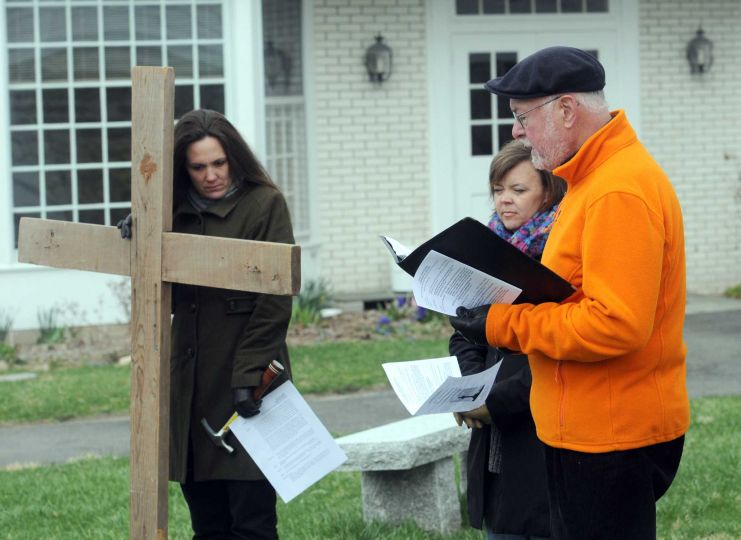
The Rev. Bryn Smallwood-Garcia leads a prayer outside the Congregational Church of Brookfield at the start of a Stations of the Cross walk to mark Christ's journey on Good Friday. Church member Pat Roehling holds the cross at left.

Christians walk, reflect on Good Friday

By Nanci G. Hutson staff writer
 

BROOKFIELD -- Bundled against the blustery cold, Pat Roehling was proud to walk with fellow Christians at the crossroads of routes 25 and 133 carrying a wooden cross on Good Friday morning to commemorate Jesus' crucifixion.

As the Congregational Church member pondered the solemn occasion -- Roehling was one of those chosen to carry the symbolic cross -- she said she felt honored to share in the remembrance of Christ's sacrifice.

In this time of crisis -- this week marked the fifth anniversary of the war in Iraq -- Roehling said Christians should be reflecting to renew their faith.

"It makes me remember," she said of walking with about 25 people from four different churches in her first ecumenical Stations of the Cross walk. "It just makes me feel very, very good."

At noon in New Milford, a larger group of Christians gathered on the steps of First Congregational Church for a "faith" walk around the town green, stopping at different places to read Scripture, sing hymns and reflect on the meaning of Christ's final journey.

With the sound of a jackhammer in the background, the Rev. Matthew Yukon of Northville Baptist Church passed around a piece of a thorn bush he picked when he was a seminary student in Israel. The thorn was similar to those made into a crown and put on Christ's head before he was led to his death.

Yukon offered a prayer of thanks for Christ's courage and determination.

"It's beautiful," said St. Francis Xavier Roman Catholic Church parishioner Angela Watts of the New Milford walk.

She and others said they enjoy that all the churches can come together to share in a unified experience of Christ's commitment to the faithful.

"It makes me feel very peaceful, and very thankful," Watts said.

In Brookfield, the theme of each of the 14 stations corresponded to a topic pertinent to life in the 21st century. Ministers shared words of comfort and conviction as they asked others to contemplate Christ's role in their lives and his call to them from the Cross.

As Christ's people in the world, the Rev. Bryn Smallwood-Garcia of the Congregational Church of Brookfield suggested, Christians need to bear witness to Christ's love.

"We should love one another but we often don't," Smallwood-Garcia said.

Smallwood-Garcia points out that in the Scripture story of Jesus' crucifixion, even those who knew that Christ's death sentence was cruel and unjust kept silent because of fear. In today's world, people are not much different, she said.

So the call to Christians is to stand up for justice, to speak up even when others stay silent, she said.

Morgan McGovern, 8, of the Congregational Church of Brookfield, carried the large wooden cross with protruding nails to several of the stations, something she considered a privilege as it is such a key symbol of her faith. And she has been taught its significance.

"I'm glad I'm holding it right now. I feel special," McGovern said as the group walked from the old fire station to the Center School parking lot. "When I hold the cross, I feel like Jesus is on it."

Contact Nanci Hutson

at nhutson@newstimes.com

or at (860) 354-2274


Thumbs up to the Congregational Church of Brookfield

THUMBS UP to the Congregational Church of Brookfield for sponsoring an Iraqi refugee family. The war in Iraq has created thousands of refugees, but few have been allowed to come to the United States. Dr. Nafie Abtan, his wife, Suhair, and their 2-year-old son, Mutaz, are three of the lucky ones. They fled threats in Baghdad, found refuge in Jordan and then received refugee status and permission to come to the United States. The congregation has rallied around the family, helping them adjust to their new life in the United States. "All people are looking for safety," he said. "The United States is a good place to do that. It's giving us a good life."
 

Church offers housing, guidance and hospitality
to Iraqi family

Nafie Abtan, an oncologist, and his wife, Suhair, and son, Mutaz, 2, have been living in a cottage on the grounds of the Brookfield Congregational Church since November as part of its Refugee Resettlement Ministry. Photograph by Scott Benjamin.

"Within six months they are to be completely self-sufficient," said Jennifer Wurst, the coordinator for the project to assist physician Nafie Abtan, his wife, Suhair, and their 2-year-old son, Mutaz.
The Abtans are the second family to occupy the cottage on the church's property, located near the intersection of routes 133 and 25.
"The United States is a very nice country," Dr. Abtan said in an interview last week at the cottage.
The housing has been maintained, in part, through money raised each October during the church's annual Yankee Fair fund-raiser, which attracts shoppers from the Greater Danbury area.
"People are friendly," he said, noting that they have gotten him and his family involved in activities at The Brookfield Library and the Regional YMCA of Western Connecticut's Greenknoll branch.
Then-pastor Peter Wiley initiated the church's Refugee Resettlement Ministry in 2000.
The first family came from Liberia and has since settled in the Midwest, according to a news release from the church.
"Iraq is in a bad situation," Dr. Abtan said of his strife-torn nation, which has been occupied by American military forces since March 2003. "There is no security."
He and his family had been living in Jordan for about a year before Interfaith Refugee Immigrant Services, which is based in New Haven, made arrangements for them to move to the cottage in Brookfield.
The Rev. Bryn Smallwood-Garcia, the current pastor, said that about 40 parishioners have helped the family in some form.
"It's part of our mission to offer hospitality to a stranger," she said. "I think there are other churches that would love to be able to do this but don't have the facilities."
David Kessler, who is friends with Rev. Wiley and a dentist with Dental Associates in Newtown, has provided free services for both of the families that the church has sponsored, and he has offered guidance to Dr. Abtan as he attempts to become a certified physician in the United States.
Dr. Abtan, an oncologist, said that he might have to complete additional educational requirements to get certified.
He said that he and his family have enjoyed the three months that they have already spent in Brookfield and hope to live in the Greater Danbury area in the near future.
"They' e been very grateful for what we've been able to offer to them," said the Rev. Jennifer Whipple, the associate pastor.
The Rev. Smallwood-Garcia said that parishioners also have benefited by acquiring knowledge of another culture through their interaction with the Abtan family.
©The Brookfield Journal 2008


Iraqi Refugees Reach City

by Allan Appel | November 19, 2007 8:27 AM |  Allan Appel Photo

thanks refugees A year and a half after fleeing Iraq, Mutaz Abtan, his mom Suhair, and his dad Dr. Nafie Abtan were at a pre-Thanksgiving feast in a strange place called New Haven, and thankful to be alive.

The family arrived in town less than a week ago, making them among our area’s — and the state of Connecticut’s — very first Iraqi refugees.

Many members of the family have been killed in the Iraq war. Dr. Abtan was threatened with death unless he left his Baghdad clinic. When he did leave, the family spent a year and a half in refugee facilities in Jordan.

They expressed their gratitudeSaturday — and smiled despite exhaustion, jet lag, and culture shock — with dozens of other refugees and their sponsors at the third annual Thanksgiving supper of IRIS, aka Integrated Refugee and Immigrant Services. IRIS is the former Interfaith Refugee Ministry, located on Nicoll Street.

In the United Church’s parish house on Temple Street, New Haven volunteers who purchased the food started cooking at 8 a.m. They sang Thanksgiving songs for the Abtans and two dozen other refugee families from Burundi, Cuba, Somalia, Sierra Leone, Afghanistan, Chad, and Sudan among others.

Although the Bush administration has pledged to resettle 7,000 Iraqi refugees in 2007, by the end of last year barely 2,000 had arrived. And with some two million fled to Syria, Jordan, and other countries and another two million internally displaced, the number seems awfully small, especially in light of the many translators and others who have been working with American forces.

Abtan said that many doctors in his clinic had already been killed, and that the threat to him, delivered in a letter, said he would be beheaded if he did not leave. “So many doctors and lawyers in my country,” he said with exhausted sadness, “have fled. And it continues.

“My nephew Amar Ali was killed two months ago on Sept. 13, and he was my sister’s only child. My brother, a technology expert, is in Syria. His son Omar has just fled there too. With that name, a Sunni name, Omar, he was at great risk.” (Click here for an article CNN did on Abtan in March.)

nhi-%20thanksrefugees%20008.JPG

The Abtans are fortunate enough to be among the only 25 percent of the refugee families coming into IRIS’s orbit in Connecticut fully sponsored by a group or institution — in this case the Brookfield Congregational Church. Gordon and Sally Markiewicz (pictured with the Abtans) represented a congregational committee of some 30 or 35 people helping to acclimate the Abtans. “They’re living in a small house, a cottage on the church grounds,” said Gordon Markiewicz, “and we’re working to help them process Social Security, Medicaid. We’ve got some committee members deployed to get them the transportation they need, step by step.”


Dr. Abtan said their needs are met; only transporation remains difficult out in Brookfield. IRIS provides sponsors technical support, such as manuals, advice on how to negotiate various agencies, legal assistance and advice on a range of other issues like cultural sensitivities. IRIS assists about 30 families or about 100 people a year. It is one of only four Connecticut non-profits licensed by the federal government to do so.

Markiewicz said that although the congregation had expected an Iraqi family for some time, it did not know until a week ago that it would be this one. The Abtans arrived from Jordan after 30 hours of flying, Tuesday night in Newark. Connecticut Limo brought them to New Haven, where the congregation’s representatives met them.

This bright afternoon, Dr. Abtan, who is an oncologist, appeared exhausted. He spoke English well, several times saying ‘“nshallah,” or “God bless/thank God.” He said he did indeed know of Thanksgiving in Iraq, as Iraqi Christians celebrate it, calling it “Eid Al Shukor.”

Suhair Mutaz said she was enjoying the turkey, although it is a highly unusual food for her family. Mutaz was not into the turkey, but he was clearly adept at making friends with the dozens of children who circulated around the festive parish hall, where the universal giggling lingo was the shared language of young childhood.


The hall was filled with refugees in America for periods ranging from the Abtans’ three days to up to three years. This remarkable family — Naim Muhammad Daud, his wife Karima, and daughters Naeeda (on the right) and Bahara (another girl and two boys were working) — came to New Haven and IRIS from Kabul, Afghanistan, two years ago after escaping from the Taliban. A commercial pilot in his home country, Daud is working in the food business in Clinton, where he now lives. Why Clinton? His two boys, age 21 and 19, have jobs there, and Naeeda will be starting work at Dunkin’ Donuts tomorrow. She and a sibling also attend Gateway Community College. They are all pulling together. Sound like a familiar American story?


“I have a car with 75,000 miles on it,” he said. “I go from place to place to plan a grocery store that I hope to open up in Milford next year. I drive so much because I don’t know things. I bought a sink for the store, but then I discover it has to be a commercial sink, not a residence. It’s my fault I don’t know. I want to buy a certain kind of paper cup for the store, and I think I have to go to New York to get it, when I discover it is in Clinton.”

He said all this with a smile on his face but wistfulness as well. “I’m very sad for my country. We will never return to Afghanistan. We will buy a house here, make a life here. What we lose in Afghanistan, we find in America, where we are safe and independent. But we must work hard.”


Chris George, the executive director of IRIS, was circulating with great pleasure. Here he was serving turkey and the proverbial fixins to Salah Arale, arrived at IRIS just six weeks ago from Somalia. “Habash,” George said, “and no chanzir” — that is “turkey, but no pork,” he reassured Arale.


After a Peace Corps stint in Oman, George spent 20 years in Lebanon, Gaza, and other locales in the Middle East, with various organizations such as Save the Children. He speaks workable Arabic. He clearly loves this assignment the best.

“You know it’s absolutely wonderful how courageous these people are, and how IRIS attracts so many volunteers to help in so many ways,” he said. He explained that each refugee receives a one-time $850 grant for resettlement purposes. After that IRIS helps them obtain Medicaid or Husky, which they are all eligible for. “We try, of course to find housing and jobs.” And a food pantry, provided by the Connecticut Food Bank, saves, according to George, about $70 per week for each family.

Yet it’s unlikely that Dr. Abtan will be able to practice as an oncologist. “We have one man,” George said, “a Somali who worked as an attorney in the ministry of foreign affairs. Now he’s working in a factory putting parts of some kind together. Most of the people earn minimum wage, have the whole family pitch in, but they are deeply grateful to be able to raise their kids in safety. And what’s remarkable, although they earn minimum wage often, they find the means to send money to their relatives back in the refugee camps. In Dr. Abtan’s case, we will try to find him work closer to his medical training.”

If a family does not have an institutional sponsor as the Abtans did (a large family from Burundi was sitting at a nearby table to celebrate, along with their sponsors, the Guilford Episcopal Church), IRIS settles them close to the Nicoll Street offices so the adults can attend the ESL classes and the kids the local school. Groups, congregations and individuals contribute funds or pieces of the resettlement puzzle. To take on an entire family as the Brookfield Congregation has done — the ideal arrangement — happens only with one in four. For the kids settled around IRIS offices, younger ones up to the eighth grade attend the remarkable classes at East Rock Magnet School, and high school age children go to the ESL programs at either Hilllhouse or Wilbur Cross.

 Muhammud Saleh, on the far right, for example, arrived two years ago from Somalia with his mom, Harima, standing beside him. They live in the area with an unrelated Somali family who arrived two months ago after a 15-year sojourn in refugee camps in Kenya (with whom they are posing in this picture along with volunteer Donna Golden and Chris George hoisting up a young pal, Muhammad Rashid).


Twelve-year-old Muhammad’s English is slow but steady. He especially likes the science he is learning at East Rock and doesn’t know yet what he’s going to do when he grows up. In the meantime he already has a job, as the unofficial family English translator.

“Let’s not forget,” said Chris George, “how much people in Greater New Haven benefit from these people. Just look around. When the kids from Burundi go to high school out in Guilford, the American kids in their classes learn geography firsthand, learn to grasp the world in this new and important way. These people are helping to globalize New Haven, and they attract so many volunteers. The $850 that the government gives per refugee, it’s leveraged a gazillion times over by the contributions people make in time and money. People love being around our families. We should quadruple the size of the national refugee program, from the 50,000 allowed in now to 200,000, and a state like Connecticut should have far more than 400 refugees total per year.”


For those wanting to learn more about IRIS or to pitch in, email here or phone 562-2095

After one of the volunteers sang and taught a rousing version of “This Land Is Your Land” by Woody Guthrie, the Abtans and their sponsors realized they had to leave. They were driving back to Brookfield. Dr. Abtan needed several adapters because Iraqi voltage runs at 220, not the American 110. On the way home, the Markiewicz were going to bring them to Radio Shack.


Iraqi refugees celebrate first Thanksgiving in Conn.

by News Channel 8's Tina Detelj
Posted Nov. 21, 2007
5:20 PM

Brookfield (WTNH) _ Caught in the middle of a chaotic war zone, an Iraqi family is now calling Connecticut home.

Nafir Abtan  may not be American, but the Iraqi refugee is giving thanks for being able to call a cottage in Brookfield his home.

"It was difficult and hard journey but we reached U.S.A., this is the point," Nafir said.

He, his wife Sufir and their two year old son Mutaz arrived in Brookfield seven days ago. They were among the first Iraqi refugees to settle in Connecticut.

"We need this land, this country, to give us the safety to me, my wife and my child, for future," said Nafir.

In Iraq Nafir was a successful doctor, but last June Nafir received a letter threatening to kill his family if they didn't leave the country. They made it to Jordan where they were able to receive their visas to America.

"We are glad now to have safety and they arranged to us everything," Nafir said.

Their American home, food and help is all courtesy of the Brookfield Congregational Church and the New Haven-based Integrated Refugee and Immigrant Services. Now the Abtan's are adjusting to the culture, learning the language.

But they are not as optimistic about the future of Iraq.

"We hope so to get better in Iraq but it takes a long time," said Nafir.

The Abtan's will spend tomorrow with a Brookfield family enjoying a traditional Thanksgiving dinner.


This page was last updated on 04/01/2008 08:48 AM.
Please send any feedback, updates, corrections, or new content to .